
7 min read · Updated November 2026
Rigging gear and how it is inspected
Rigging gear is inspected before use, every time, by someone qualified to spot damage, and anything defective comes out of service. Slings must carry their rated capacity, hardware must be marked, and the load, angles and attachment points decide what gear is chosen.
- Nevada Contractors License 46276
- USDOT 642556 · our own trucks
- 4.6 on Google (15 reviews)
Key points
- Slings, shackles, hooks and hoists are inspected before use
- Rated capacity must be legible and never exceeded
- Sling angle changes the load on each leg, sometimes sharply
- Damaged gear is removed from service, not patched
- 'Qualified' is the employer's determination, not a card OSHA issues
Rigging failures are rare, and nearly all begin with gear that was damaged, overloaded or used at a bad angle. The rules below come from OSHA and from the ASME B30 standards, which we cite by name only. We describe what they require and what the owner and the rigger each have to do. This guide describes what the rules and standards say.
The gear in a machinery lift
Common items include wire rope, chain and synthetic slings; shackles, hooks and eye bolts; hoists and chain falls; spreader and lifting beams; jacks, skates and rollers; and gantries. ILS publishes its own list as rigging, slings, hoists and a large inventory of power and hand tools, with a 2-ton portable aluminum gantry and a 300-ton hydraulic gantry system. The gear is chosen from the load and the plan, not by habit.
What the rules say
For general industry, OSHA 29 CFR 1910.184 covers slings: each sling is inspected before use, carries its rated capacity identification, and damaged slings are removed from service. For construction, 29 CFR 1926.251 sets similar rules for rigging equipment, including a safe working load marking and inspection before each shift. ASME's B30 volumes cover slings (B30.9), rigging hardware (B30.26) and jacks and gantries (B30.1) in more detail.
Nevada operates its own OSHA state plan through the Division of Industrial Relations and adopts the federal standards by reference, so the same rules apply in Nevada.
A pre-use inspection checklist
- Read the identification tag or marking and confirm the capacity is readable.
- Check for cuts, fraying, broken wires, kinks, crushing or heat damage on rope and synthetic slings.
- Check chain links for stretch, gouges, twist or bent links.
- Inspect shackles, hooks and eyes for deformation, cracks, wear and a working latch.
- Check that pins and bolts are the right type, seated and secured.
- Confirm no knots, and no sharp edges against the sling without padding.
- Tag and remove anything doubtful from service.
Why angle matters
A sling's rated capacity is stated for a given angle. As the legs spread toward a flatter angle, tension rises in each leg. That is why the lift plan includes a sketch of the rigging, not just the weight. Choosing a longer sling or a spreader beam often solves the problem.
| Sling angle from horizontal | Effect on each leg |
|---|---|
| 90 degrees (vertical) | Tension equals its share of the load |
| 60 degrees | Modestly higher than vertical |
| 45 degrees | Substantially higher than vertical |
| 30 degrees | Roughly double its share of the load, so avoid |
What the owner should expect to see
On site, you should see slings with legible tags, hardware matched to the load, padding where slings meet edges, and a clear zone beneath the lift. If a rigger shows you a sling with a missing tag or visible damage, the right response is that it is set aside. Ask questions freely; a good crew treats them as normal.
Who is qualified
OSHA's construction rules require a qualified rigger for hoisting work where employees are in the fall zone and during assembly, and they leave the determination of who is qualified to the employer (29 CFR 1926.1425(c)(3) and 1926.1404(r)(1)). OSHA does not issue rigger cards. When you hire, ask how the contractor trains and evaluates its riggers; see how to choose a rigging contractor.
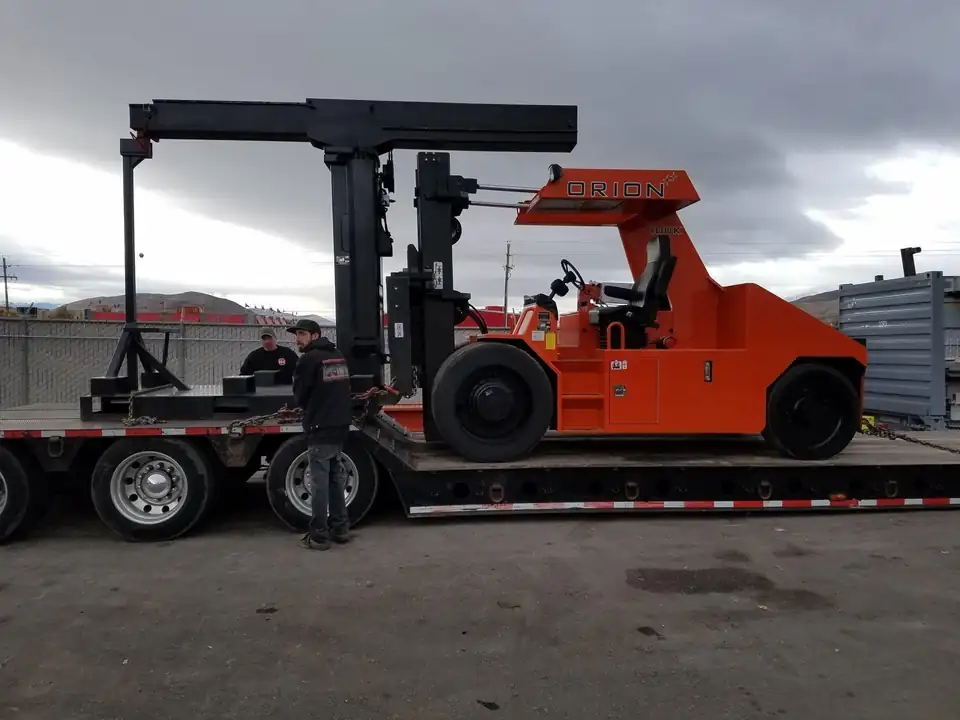
Powered industrial trucks, including forklifts with rigging booms, require operator training and evaluation under 29 CFR 1910.178. See our rigging equipment and lift planning basics.
Sources (4)
- U.S. Occupational Safety and Health Administration: osha.gov/laws-regs/regulations/standardnumber/1910/1910.184 (checked November 2026)
- U.S. Occupational Safety and Health Administration: osha.gov/laws-regs/regulations/standardnumber/1926/1926.251 (checked November 2026)
- Electronic Code of Federal Regulations: ecfr.gov/current/title-29/part-1926/subpart-CC (checked November 2026)
- ASME: asme.org/codes-standards/find-codes-standards/b30-9-slings (checked November 2026)
Send the machine details
Type, size, weight, where it is and where it is going. Photos help. Estimates are free.
Start the estimateLicensed in Nevada
Nevada State Contractors Board licenses 0046276 (C-33 Installing Industrial Machinery), 0083124 (A-14, A-20) and 0083125 (C-14I Rigging and Cranes, C-14J Conveyance of Goods). USDOT 642556, MC-531191.
What the classes coverHow often should rigging gear be inspected?
Before use, as OSHA requires, with periodic documented inspections as the ASME B30 standards describe. The user checks it each time it goes on a load.
Can a damaged sling be repaired?
Generally not by the user. Follow the maker's guidance; repairs to alloy chain and hardware are for the manufacturer or a qualified person.
Does OSHA certify riggers?
No. OSHA leaves the question of who is qualified to the employer, which makes the contractor's training process worth asking about.
Free estimates
Tell us what needs moving.
Free estimates on every job, big or small. Call the office or send the machine details and we will call you back.
(775) 882-3319Monday to Friday, 7:00 am to 4:00 pm. Fax (775) 882-2693.
- Nevada Contractors License 46276
- USDOT 642556 · our own trucks
- Carson City since 1999
- 4.6 on Google (15 reviews)