
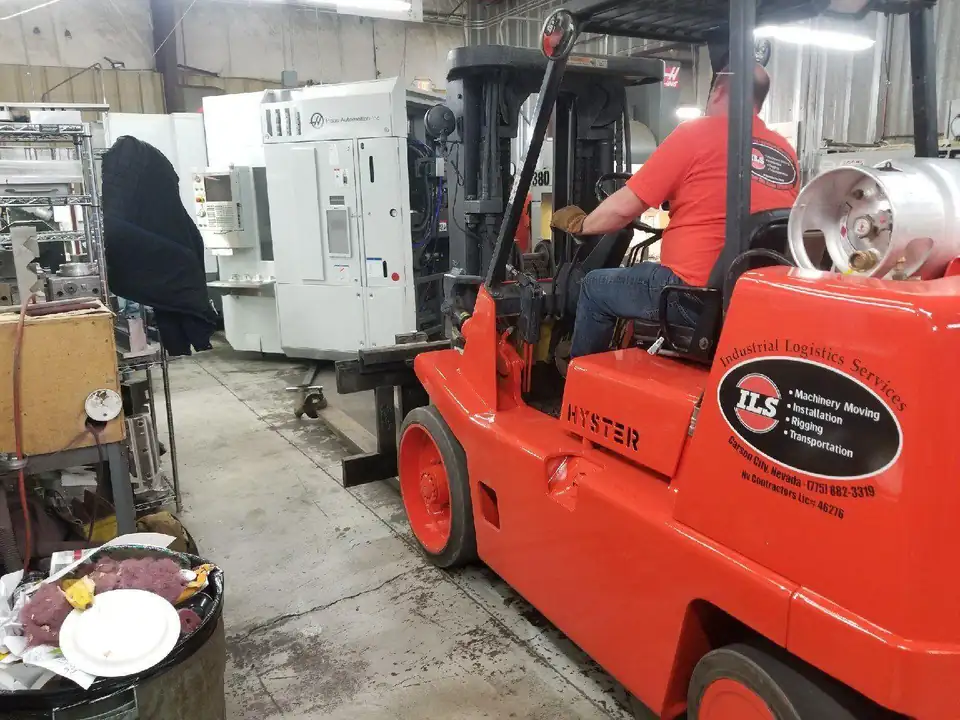
Moving CNC machines
A CNC machine is moved by locking down its moving axes, draining or securing its fluids, lifting it from the manufacturer's lift points and setting it on a trailer or skates, then leveling it again at the new location. ILS handles the rigging, the haul and the setting with forklifts from 3,000 lbs. to 100,000 lbs. with rigging booms and its own trucks.
- Nevada Contractors License 46276
- USDOT 642556 · our own trucks
- 4.6 on Google (15 reviews)
Key points
- Axes are locked or blocked before any lift
- Coolant, hydraulic and way-lube fluids are drained or secured
- Lift only from the lift points and fork pockets the maker shows
- The machine is leveled and checked again after it is set
- Forklifts from 3,000 lbs. to 100,000 lbs. with rigging booms
- Free estimates from your photos, nameplate data and route
CNC machining centers, turning centers and routers look like solid blocks of iron, but they hold a spindle, ways, ballscrews and a control cabinet that all depend on being kept square. Moving one is mostly about protecting those parts and getting the machine back to the accuracy it had before. Industrial Logistics Services in Carson City moves, rigs and installs machinery for plants and shops across Northern Nevada.
What makes a CNC machine tricky to move
The weight is rarely the hard part. A mid-size machining center may be moved on a forklift with a rigging boom, while a large gantry-style machine can take a hydraulic gantry. What causes trouble is that the weight sits high and off to one side, the table and spindle head can shift if they are not locked, and the control cabinet, the chip conveyor and the coolant tank all have to travel with the machine without being crushed.
Machine makers publish the weight and the lift points in the installation manual and often on a nameplate. A rigger works from those, because lifting a machine by its casting in the wrong place can crack it or twist the base.
Preparing the machine
The plant's own maintenance team normally shuts the machine down and locks out its power before anyone else touches it. OSHA's lockout/tagout rule at 29 CFR 1910.147 covers that step, and our guide on lockout/tagout before a move explains who does what. Then the machine is made ready to travel.
- Lock out and disconnect power, air and any coolant or chip lines
- Drain or secure coolant, hydraulic oil and way lube as the manual directs
- Park the axes in the maker's shipping position and install the transit blocks or locks
- Remove or secure the tool changer contents, tooling, chuck jaws and any loose parts
- Photograph the cabinet wiring and label the cables before they come off
- Measure the doors and route and confirm the lift points
Rigging and hauling
Small and medium machines are often picked with a forklift or placed on machinery skates and rolled. Larger machines go onto a lowboy or step deck, chained down at the base and padded where straps touch the sheet metal. A 300-ton hydraulic gantry system is part of the published equipment list for loads that cannot be forked. ILS has the capacity of moving and relocating equipment weighing up to 300 tons, and its equipment trailers run to 50 tons.
If the machine is wide, tall or heavy enough to need a Nevada over-dimensional permit, the load has to follow NRS 484D and the permit terms. The oversize load checker shows where the legal limits sit.
Setting and leveling after the move
Once the machine is on its new pad, it is set on its leveling feet or shims and brought level with precision instruments. ILS lists optical levels and theodolites (1 arc second), high accuracy laser levels and spirit levels accurate to .0005" in 12". A machine that goes back to work out of level can cut out of tolerance, so the leveling is done before power is reconnected. Our pages on precision leveling and alignment and machine installation describe that work, and how machines are leveled goes into the method.
The final power, control and calibration steps follow, with the maker's service technician where the maker requires; who handles the power is agreed in the estimate. We coordinate the timing so the machine is ready when they arrive.
What to send for an estimate
Send the maker and model name from the nameplate if you have it, the weight and the overall length, width and height, photos of the machine and the path out of the building, and the address where it will be set. The machine measuring worksheet lists what to capture. Estimates are free.
ILS moves CNC machines across Northern Nevada, including Reno, Sparks, the Tahoe-Reno Industrial Center, Carson City and the Carson Valley, from its yard in Carson City.
Sources (3)
- U.S. Occupational Safety and Health Administration: osha.gov/laws-regs/regulations/standardnumber/1910/1910.147 (checked November 2026)
- U.S. Occupational Safety and Health Administration: osha.gov/laws-regs/regulations/standardnumber/1910/1910.212 (checked November 2026)
- ASME: asme.org/codes-standards/find-codes-standards/b30-9-slings (checked November 2026)
Send the machine details
Type, size, weight, where it is and where it is going. Photos help. Estimates are free.
Start the estimateLicensed in Nevada
Nevada State Contractors Board licenses 0046276 (C-33 Installing Industrial Machinery), 0083124 (A-14, A-20) and 0083125 (C-14I Rigging and Cranes, C-14J Conveyance of Goods). USDOT 642556, MC-531191.
What the classes coverCan ILS move a 40,000 lb CNC machine, for example from Sparks to Carson City?
Yes. 40,000 lbs. is 20 tons, inside both ILS's forklifts from 3,000 lbs. to 100,000 lbs. with rigging booms and its trailers to 50 tons. The method (forklift, skates or gantry) comes from the lift points and the floor; Sparks is 36.0 road miles from the Carson City yard, and the estimate is free.
Can ILS move a CNC machine and set it up at the new shop?
Yes. ILS moves the machine, hauls it and sets it on the new foundation or floor, then levels it. Who wires it to the plant's power is agreed in the estimate, and the maker's technician handles calibration.
Does the coolant have to be drained?
Usually the maker's manual says to drain or secure coolant and way lube before a move, because sloshing fluid shifts weight and can leak onto the road or the floor. Follow the manual for your machine.
How heavy a CNC machine can you move?
ILS has the capacity of moving and relocating equipment weighing up to 300 tons. On the road, ILS's published trailers are rated to 50 tons (100,000 lbs.) per load; in the building, its forklifts lift from 3,000 lbs. to 100,000 lbs. with rigging booms and the 300-ton hydraulic gantry system handles heavier lifts. The method depends on the size and weight of the machine and the route.
Free estimates
Tell us what needs moving.
Free estimates on every job, big or small. Call the office or send the machine details and we will call you back.
(775) 882-3319Monday to Friday, 7:00 am to 4:00 pm. Fax (775) 882-2693.
- Nevada Contractors License 46276
- USDOT 642556 · our own trucks
- Carson City since 1999
- 4.6 on Google (15 reviews)