
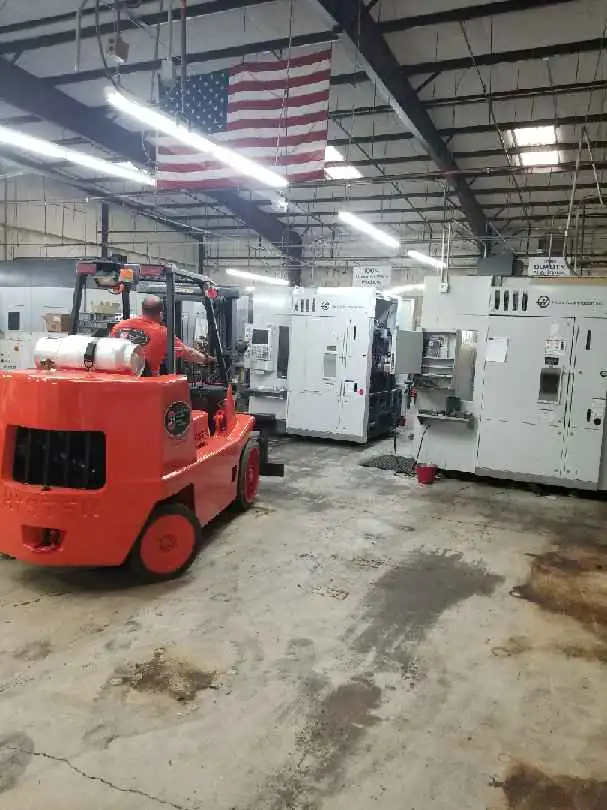
Moving lathes and milling machines
Lathes and mills are moved by securing the carriage, tailstock, table and head, lifting from the base with slings or a forklift boom, and rebuilding level on the new floor. ILS rigs these machines and levels them with optical levels and spirit levels accurate to .0005" in 12".
- Nevada Contractors License 46276
- USDOT 642556 · our own trucks
- 4.6 on Google (15 reviews)
Key points
- Cast-iron beds are lifted from the base, never by the ways
- Carriage, tailstock, table and head are locked before lifting
- Long beds are supported so they do not twist in transit
- The machine is leveled on its feet or pads at the new location
- Spirit levels accurate to .0005" in 12" are on the equipment list
- Free estimates, single machines welcome
Manual lathes, knee mills, toolroom machines and heavy engine lathes are the older workhorses of many machine shops, and they are often very heavy for their size. They carry long cast-iron beds, and bed twist is the enemy. Industrial Logistics Services moves these machines as part of its machinery moving and installation work from the Carson City yard.
Why bed twist matters
A lathe bed or mill column is a long casting whose accuracy depends on staying straight. If it is lifted at the wrong points, hung from a sling that squeezes the casting, or hauled on a trailer that lets it flex, it can lose geometry that is expensive to restore. For that reason riggers lift from the base casting or the maker's lifting points and keep the bed supported along its length.
Older machines may have no manual and no lift points. In that case the rigger inspects the casting, decides where a sling or fork can safely bear, and tells you what that plan is before the move.
Getting ready to move
Your maintenance team disconnects power and locks out the machine under the plant's lockout program (29 CFR 1910.147). The machine is then readied for the road.
- Disconnect and lock out power, then cap or label coolant and lube lines
- Drain the apron, headstock and gearbox oil if the maker calls for it
- Lock the carriage, cross slide, tailstock and quill, and tie the table on a mill
- Remove chucks, steady rests, vises and loose tooling and crate them
- Wrap or tape exposed ways and handwheels so nothing is struck in transit
- Photograph the machine, its feet and the floor anchors before disconnecting
Rigging methods
Smaller toolroom lathes and mills can often be lifted with a forklift and set on a pallet or skid. Larger and heavier machines are rigged with slings and a rigging boom, or lifted by a hydraulic gantry when floor space and headroom limit a forklift. Slings, hardware and hoists are inspected before use under 29 CFR 1910.184, and the ASME B30 standards cover that equipment.
The published ILS equipment includes forklifts from 3,000 lbs. to 100,000 lbs. with rigging booms, a 2-ton portable aluminum gantry for tight spots, and a 300-ton hydraulic gantry system. Read more on the portable gantry page.
Setting and leveling a lathe or mill
After the machine is placed, it is leveled on its pads or leveling feet. A lathe is checked along the bed in both directions and for twist, and a mill is leveled at the table. Many shops grout or bolt the machine to the floor, which can count as installing industrial machinery. ILS holds Nevada contractor license 0046276 in the C-33 Installing Industrial Machinery classification. The details are on the machine installation page.
Fine alignment tests, such as spindle runout and geometry checks, belong to the shop or the maker's technician after the machine is set.
Estimate checklist
For a free estimate, send the nameplate details, approximate weight, the overall footprint, a photo of the machine and the exit path, and the new address. If you do not know the weight, a photo and the model name are enough to start. Our guide to measuring a machine for a moving estimate helps.
Sources (3)
- U.S. Occupational Safety and Health Administration: osha.gov/laws-regs/regulations/standardnumber/1910/1910.184 (checked November 2026)
- U.S. Occupational Safety and Health Administration: osha.gov/laws-regs/regulations/standardnumber/1910/1910.147 (checked November 2026)
- ASME: asme.org/codes-standards/find-codes-standards/b30-9-slings (checked November 2026)
Send the machine details
Type, size, weight, where it is and where it is going. Photos help. Estimates are free.
Start the estimateLicensed in Nevada
Nevada State Contractors Board licenses 0046276 (C-33 Installing Industrial Machinery), 0083124 (A-14, A-20) and 0083125 (C-14I Rigging and Cranes, C-14J Conveyance of Goods). USDOT 642556, MC-531191.
What the classes coverDo you move old lathes that have no manual?
Yes. The rigger inspects the machine, picks the lift points and describes the plan before the move.
Can you bolt a lathe to the new floor?
ILS holds a Nevada C-33 Installing Industrial Machinery license. Anchoring and grouting a machine are covered on the machine installation page.
Do you move a single machine?
Yes. Single machines and whole shops are both welcome, and estimates are free.
Free estimates
Tell us what needs moving.
Free estimates on every job, big or small. Call the office or send the machine details and we will call you back.
(775) 882-3319Monday to Friday, 7:00 am to 4:00 pm. Fax (775) 882-2693.
- Nevada Contractors License 46276
- USDOT 642556 · our own trucks
- Carson City since 1999
- 4.6 on Google (15 reviews)